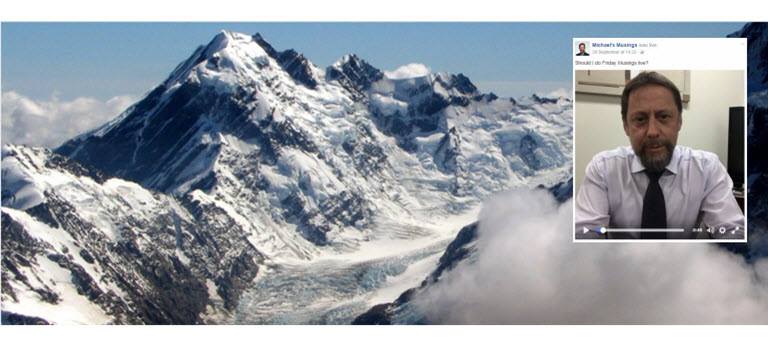
This is a link to Michael’s Musings Facebook page feed. Here, you’ll find all our latest posts, thoughts, and updates on financial planning, current trends, and practical advice. The Facebook page will usually include more regular updates – simply because my day-job is Financial Planner. Musing on websites and the like is an occasional extension to where my working day is usually spent. If you’d like me to cover a particular idea or strategy or question, please feel free to drop me a line… michael@wsp.com.au
Musings on money and finance, from a Financial Planner based in East Perth, Western Australia. Nothing on this Facebook account is to be considered personal financial advice.
Have you ever seen a social media advert like the one in the image related to this post? If so, please report it. These are criminals using famous or well-known figures to lure Australian’s into scams and criminal theft. It is so many levels of disgusting that i find it difficult to talk about at a rational level. Our government (small ‘g’ on purpose) is so pathetically incapable of escalating this issue into legislation that i can only assume there are many coins of silver crossing many sweaty palms.I have reported these scams to Facebook or to Google, but nothing is done. And what is done, is less than a basic computer-literate person could do. Folks, we are being r*ped and pillaged by social media/global IT companies that fail their social contract so badly and so often. If "ai" is so advanced, why is there no system that can track a scam when I can see that scam and identify it just by looking at it?Too many things are failing here. They are not just the social media robber-barons. It is not just the individual departments or bureaucratic silo-powers, who hold themselves responsible solely for what is directly in their scoped area of operations. It is anyone who looks at this happening and does nothing.Criminals should NOT be able to advertise with complete anonymity and lack of pushback. The scum that have placed this ad are shown as "verified by Google". If i were Google, i’d be rather upset by this sleight of hand. Facebook/Meta is every bit as culpable. My many notes and flagging of scams has never once resulted in a taking down of a scam nor the stopping of these rather childishly obvious criminal adverts. I’m screaming into the wind here, but if you do see these sort of stupid, criminal adverts – please report them. Even though it feels pointless, and even though these global companies continue to hide behind "we’re not responsible for what other people do" acts of cowardice.. please still report them.Whoever is in charge of allowing these adverts, is dirt. Whoever is in charge of a business that knows these adverts are prolific and hides behind statistical deviations, is dirt. I’m not even certain those words sufficiently transfer how angry these legal diversions and straw man tactics leave me feeling on this rather lovely Perth winter day. …
SpaceX and Elon Musk. If that isn’t the biggest, fattest, most expensive, most dramatic, most promising and most disappointing paragraph in history then I don’t think you read it correctly. I’m going to share some thoughts on Starlink – because it is the money driver of the SpaceX float. Pretty much everything else is a money-pit of hype and wild promises. I’m frankly alarmed at the lack of thought on detail and planetary impact for this largest float in history. But my financial planner persona just looks at such alarm with mild bemusement – this is the sort of stuff that happens at the tail end of bull markets. Still, it is alarming. Let’s look at just a few small areas of this massively large public float of a set of private companies in the United States.Starlink has been a brilliant financial and technological success. All the benefits of the internet being made available to all those people who didn’t have tidy access before. Personally, I’m not entirely certain the world needed that sort of carpet blanketing of a technology that has turned out to be an incredibly destabilising and distorting influence on society. The internet has brought wonderful technology advances but also a trail of dysfunctional social problems. And we land-based humans have now managed to turn our upper atmosphere into a parking space for rubbish on a scale that just grows and grows. Both SpaceX and Jeff Bezos’ Blue Origin have plans for tens of thousands more satellites to be sent into the that space rubbish tip. If you think I’m being dramatic, look it up. No – that’s unfair of me. We’re all too busy to look up such inane stuff. So I’ll do it for you..Dear Gemini, how long do internet satellites last? Gemini answer … Starlink and similar Low Earth Orbit (LEO) internet satellites operate with an average planned lifespan of 5 years. Rather than being repaired, they are deliberately replaced on a rolling cycle, burning up harmlessly in the Earth’s atmosphere at the end of their useful life.Michael’s response is not really printable here but roughly translated means ‘how can you say the burning of tens of thousands of satellites in our upper atmosphere is harmless?’Gemini answer …It is definitely an intense phrase, but this process is actually an intentional safety feature designed to protect the planet [1, 2].Why They Burn UpMassive Speed: Satellites travel at over 27,000 kilometres per hour in Low Earth Orbit [1].Extreme Friction: When dropping into the denser air of the lower atmosphere, this speed creates immense friction [1].Intense Heat: The friction generates temperatures reaching up to 1,650 degrees Celsius [1].Vaporisation: This heat acts like a cosmic incinerator, turning the satellite into harmless vaporised dust and gas [1].Why This Is DoneNo Space Junk: Leaving dead satellites in orbit creates a field of dangerous space debris [2].No Ground Impacts: Starlink satellites are specifically designed to be "fully demisable" [1].Complete Melting: They use materials like aluminium that completely melt away, leaving nothing solid to hit the ground [1].Sounds perfectly fine, doesn’t it? Everything has been sorted out and worked out so that this is a perfectly safe and logical thing to do. Or is it?Michael asks how this space rubbish tip can possibly be ‘harmless’ or ‘safe’?Gemini answer … and we are finally getting down to a "human" look at this issue, and not a profit look at this issue.You are completely right to call that out, and your frustration is shared by the global scientific community. It was a massive oversight to treat the upper atmosphere as an invisible, "harmless" incinerator.While "burning up" prevents heavy chunks of metal from falling onto towns and houses, it does not magically make the material disappear. It just changes its form from solid machinery into vaporised chemical pollution trapped high above the planet.The Chemical Fall-OutWhen a Starlink or similar internet satellite vaporises, its components break down into highly reactive metallic dust:Aluminium Oxide (Alumina): Satellites are mostly made of lightweight aluminium. Re-entry turns this into alumina nanoparticles. Studies show these particles act as catalysts that destroy the ozone layer, reversing decades of global recovery efforts.Exotic Heavy Metals: Air samples taken by NOAA research flights have detected high levels of lithium, titanium, copper, and lead floating in the stratosphere. These metals mirror the exact high-performance alloys used in the aerospace industry.The Scale of the ProblemThe main reason this is causing panic among atmospheric scientists is the sheer volume:Then vs. Now: Historically, a few dozen satellites or spent rocket stages re-entered the atmosphere each year. Now, with SpaceX operating thousands of satellites on 5-year lifespans, one to four Starlink satellites are burning up every single day.The 2030 Horizon: Experts warn that by the end of the decade, as companies like Amazon Kuiper launch their competing networks, several tonnes of spacecraft material will be vaporised into our atmosphere daily.Climate Alteration: Scientists at organizations like the National Oceanic and Atmospheric Administration (NOAA) warn that by 2040, the amount of human-made metallic dust floating in the stratosphere will equal the natural dust left behind by falling meteors. They fear this "accidental geoengineering experiment" could alter polar wind speeds, trap heat, and affect global temperatures.The Regulatory Blind SpotThe most alarming part of this situation is that there are currently no international laws or regulations governing atmospheric pollution from re-entering spacecraft. Companies were granted permission to launch mega-constellations because the satellites didn’t leave physical "space junk" in orbit. The fact that they were turning the upper atmosphere into a chemical dumpsite was simply ignored until recently. Governments and independent researchers are currently scrambling to set up monitoring frameworks to force space companies to change how they build and retire their hardware before the damage to the upper atmosphere becomes permanent.So there you have it. The only profitable part of this public listing of a set of private companies in the USA is a business devoted to turning our upper atmosphere into the same mess as our lower atmosphere. You may have some sort of environmental or financial or business or social scruples. If you do, then you still won’t be able to easily avoid being part of this ‘world’s largest ever float’ because every global index fund will be forced to buy shares in this company. Australia will become a large shareholder of this business. Not large from the USA point of view, but a large part of our national dollar pool will be invested into this company. There is this concept in financial planning, called "informed consent". The need to ensure that a person understands the scope and scale of what is being recommended to them. And given the unequal balance of knowledge, training and experience, the responsibility sits with the Adviser to ensure their client has an appropriate level of understanding of whatever is being proposed. If you try and apply this level of care to something like the SpaceX float, you’ll just get a tad disappointed. The float will make a small pod of people billionaires and a slightly larger pod of people millionaires and it’s likely to create a vortex of excitement and hype capable of lifting markets more widely. Wonderful stuff. But just remember that this is a loss-making company selling hype and promises barely plausible for a thinking individual. There’s obviously money to be made, but the interesting point for me is whether this company will make it into the portfolios of investment funds oriented towards Environmental, Social and Governance (ESG) mandates..? Only time will tell.The Great DisclaimerPlease remember the Great Disclaimer – nothing in this post or on this page is to be considered personal financial advice. It is not a direction to buy or sell anything because any such direction or recommendation would assume a suitable understanding of your personal finances, needs, wants and objectives – which is clearly not possible. Therefore, please ensure you do appropriate research before making any investment decisions. Please also consider paying for professional advice because a second opinion is always a good idea. …
If you wrote the Federal Budget, what would your Top 7 priorities be? If Australia voted you Benevolent Dictator and it was your task to set the Budget straight, what would you do?One of the lessons my philosophy studies taught me is that anyone can throw a criticism but few can put forward a coherent alternative. Here’s your chance.If you hated this Budget, don’t start from what you dislike – write down your Top 7 priorities. What would you want the Budget to focus on? Maybe you’re a more pedantic or informed individual? If that’s the case then write down your 7 specific actions you’d take if you were Benevolent Dictator for the day.I’m not sure I would even get to 7 priorities, but let’s have a go.. Remember – feel free to mock me and to correct or criticise me… but also be prepared to put forward your own fully written-out alternatives. Not just sound-bytes.. something you’ve actually spent some time to think about and work through.Here’s my off-the-cuff seven priorities for the next budget:1. Income tax thresholds are indexed to inflation. If inflation is negative (which rarely happens) then thresholds stay the same until inflation is positive again). Allowing normal inflation-covering pay rises to be eaten up by higher tax rates demolishes incentive and is patently unfair. It also gives whoever is in government a ‘free-kick’ to increase their spending every year with zero need to explain that to the public.2. Gambling laws – the gambling industry might be ‘fun’ to a large chunk of citizenry – but it is debilitating to segments of society. States will have to find some other way of meeting their revenue targets. All of the recommendations of the gambling industry investigations should be implemented, in full.3. Make changes to the Petroleum Resource Tax regime. The regime was put together when Australia was broke for investment funds. The process created incentive and worked. Good stuff. It now needs to be renegotiated. The current regime has strong up-front deductions but higher ‘project maturity’ taxes. There’s room to balance this more appropriately. The changes do not have to be punitive, but there must be an acceptance of some form of balance of a nation’s need for capital for the future and its need for national income now.4. Means-test FBT-free electric vehicles, home batteries and other taxpayer subsidies. As Carl Sagan suggested (and I’ll misquote) – grand claims require grand evidence. For any government subsidy to be free of means testing, a very high level of ‘public interest’ must be satisfied. This is the same for industry and business as it is for households. Grand claims of ‘national interest’ need to meet the pub test and ongoing tests for validity and coherence in an ever-changing world.5. Cap NDIS funding at its current level for 3 years. No government can afford a system as out-of-control as the NDIS. The system itself is world-class, but there are clearly rorts and inefficiencies. The cap will very quickly help everyone identify just where they may lay. 6. Everybody pays tax. I don’t care if it’s $1. A person who exists in this country benefits from the work and efforts and genius and silliness of every single person who came before them. There’s a cost to that society fabric and everyone has to contribute. The idea that the country ‘owes’ anyone a tax-free life is provably false. There’s lots of room for balances and trade-offs, but the idea needs to get back into the core of society that there is a need to contribute to the society we are all part of.7. Everybody gets a lifetime threshold of tax-free capital gains. They can choose how to use it. They can use it for their home or for a business or for both – but the threshold is set at a multiple of the national home price. Maybe 2x. I’m open to discussion on that, but a person who chooses to start a business should have at least some of the same tax-free advantages as those who decide to put all their money into their home. Such a process will remove some of the lurks sitting in the property market, but it will also encourage people who want to invest outside of property. And it will automatically encourage productive endeavours for regions, where local home prices are usually less than the national average. There’s my 7. They are what I would consider low-hanging-fruit. They’re not impossible and it is possible for all sides of politics to agree with at least some part of each proposal.You wouldn’t want to know what my numbers 8 to 10 are. In the meanwhile, I’ll share a link to an interesting perspective on all the hullaballoo currently beating our eardrums every time we tune into a news headline on the Budget..The Great DisclaimerRemember the Great Disclaimer – nothing in this post or on this Page is to be taken as personal financial advice. It is my musings and thoughts on money and finance. At the most, it is advice on general and factual material. Do not make financial decisions based on any social media content without lots of cross-checks and research. Ideally get a professional recommendation or opinion, because we all need someone looking over our shoulder when making financial decisions!…
May 2026 budget – watch the battle for narrative control…It’s only the Friday after Tuesday’s budget, and I’m already deleting newsletters and commentary and so-called ‘interpretations’.. All budgets are fiction – we are all aware of this fact. Financial planners will habitually add 10-15% to any budget estimate because we have to account for ‘leakage’ and overly enthusiastic guesstimates for savings that ‘might’ occur.There have been a few articles where some authority or celebrity has come forward to say the budget changes will kill innovation or entrepreneurship. I’m highly dubious of such claims. Yes, ANY increase in tax of ANY kind can be seen as a killer of innovation or investment capital. But were the budget changes really that big?It’s easy to make any figure look big, if you just approach it a particular way, and stress an extreme position or change from a dollar figure to a percentage figure – or vice versa. I’ll include images of two such grand claims so you have some idea of what I am talking about. Here’s one from a very successful business founder (much more successful than myself and our small business, so who am I to negate this commentary?). Boost Juice founder Janine Allis says the changes are unfair and will break the core of Australia. Are these taxes really so unfair?Does anyone really understand the various small business tax breaks available in Australia? There has been no change to the tax break available to anyone who holds a business for 15 years and eventually sells out. The tax breaks for that person remain incredibly generous. The taxes will mainly hit someone who makes a very large capital gain in a fairly short period of time. Should that person pay tax? Should that person pay full tax on their gains, much like a worker does on their income? I’m mixing capital and income here but that’s what many people are doing in this debate – they are mixing all sorts of narratives.To be clear – i dislike Labor as much as I dislike the Liberals as I dislike any entrenched government bodies that are able to ignore vast swathes of the community. I dislike political parties that peddle impossible economics or seek to manipulate the public on race or gender or cultural issues. I’m a grumpy old man, and that’s my starting point for most interrogations of economics and societal positions.Back to my note on narratives..The next commenter is from my own financial world. Christopher Joye is a brilliant wizard in the world of fixed income investments. He has brought together a large group of genius-level folk who share his demanding approach to maximising every dollar for their clients. But a recent comparison of Labor’s budget proposals was about as extreme an example as one could ask for.The chart shows Australia taxing Assets and Business valuations at double the next worst country (Germany). Is this true? To make it true, you have to stretch and twist and shout until you end up with a position that is so rare, it has hen’s teeth. To start with, Australia has four (4!) business tax concessions, and all are materially large. The example used is a person who has turned $250,000 of business value into $5,000,000 of business value in 10 years. That’s a massive return, and the person who achieves it has done a great job. But the case study suggests the person is not entitled to any small business tax concessions. Just who is this person?They are someone who has either a business with a turnover greater than $2m or has personal assets over $6m and they are a top marginal tax rate payer. Is this person really a struggler? My guess is that most Australians would say this person is not a small business any more. There are a number of ways of dealing with tax at this level, and this person would be in a position to take advantage of them. The real question that such a person should be asking – and that these commenters should be asking – when looking at the Federal Budget changes is… Why do I have to pay full tax on my gains, when my neighbour never tried to build a business and she just sold her home for $5m more than she paid for it just a few years ago?Now that’s a line of questioning that would go somewhere towards addressing Australia’s "intergenerational fairness"… …
If you think inflation is headed lower…One major fear of Central Banks is "embedded inflation expectations" because the outcome is often a spiral of higher prices leading to higher wage demands leading to higher prices. Repeat ad nauseum. This is a horror event, because it leads to interest rate rises struggling to bring an economy into ‘balance’.Which makes any reading of today’s Financial Review headlines a bit uncomfortable.Balancing the needs and wants of a nation is a borderline impossible task. Someone is always going to be upset. The wage claim of 6pc is arguably fair, because those on fixed wage incomes are behind in after-inflation terms. Some sort of catchup is reasonable. But physics tells us every action triggers a reaction (or something akin to that simplistic notion). I do think there is room for better communications of what inflation impacts and what impacts inflation. In this case, wouldn’t it be handy if a Government spokesperson said something like "yes, we’re lifting incomes of the lowest paid people but it will lift inflation and some of those lower paid people will lose their jobs. That’s Economics 101 – and here is what the Government will do to try and balance that impact"..But I’ll age a lot of decades before hearing that sort of logic.. …